
Exeter Contemporary Open in Review: Nina Royle
Published November 12, 2026
Exeter Contemporary Open is celebrating its 20th anniversary this year, and while the 2026 exhibition may have closed its doors for the final time, we are continuing to spotlight its impact over the past two decades. We've been chatting to artists whose work has been previously shown as part of the exhibition. In our final interview, we spoke with Cornwall-based artist Nina Royle.
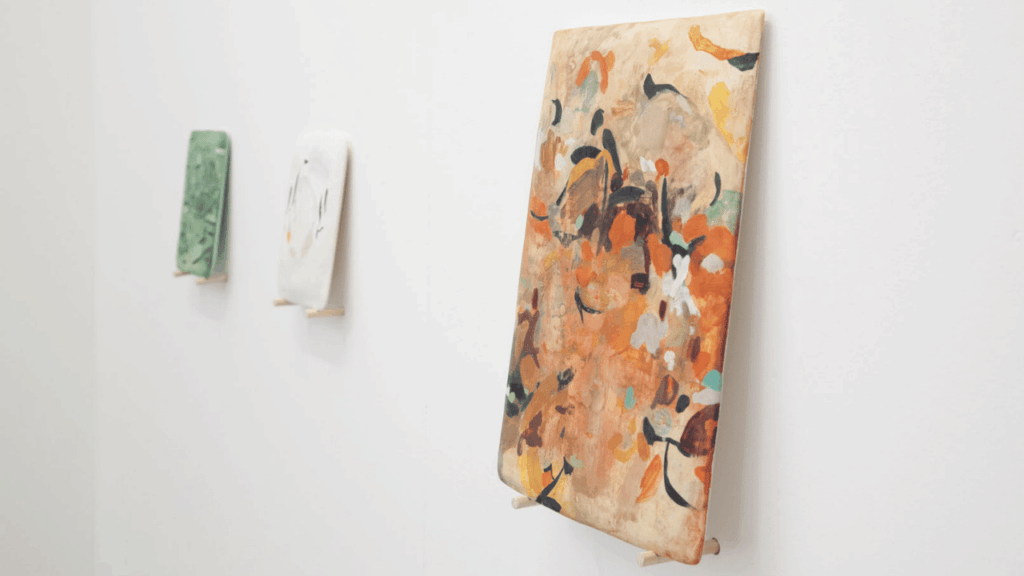
Nina: I’m based in South West Cornwall. I grew up here and returned to the area to live after completing both a BA and MA at the Slade School of Art. My practice is centred in painting but a love of investigating sculptural objects and how they might hold a painted image is also always an important question for me. I typically work on shaped wood panels coated in traditional gesso. These panels have a haptic quality to them - for the hand as much as for the eye. On to them passages of figuration and abstraction slowly accrete in ways that aim to make sense of a life lived now and its crossings with the past and future.
Can you describe what you exhibited with us when you were in the Open?
I exhibited a small collection of paintings. They were some of the first I had made using the shaped wood and gesso panels described above, which 10 years on I’m continuing to work with. The paintings contained loose clusters of abstract marks that evoked landscape and vegetation. I was interested at the time in thinking about / emphasising a relationship between how the ground of a painting holds an image and then how the physical ground that makes a landscape, also holds.
What are your memories from being in the exhibition?
After all of this time I still distinctly remember how Matt, Exeter Phoenix’s Curator & Visual Arts Manager, had taken time to sensitively present my paintings on wooden, shelf-like bars. I remember he had sent me a photo during the install to check if I was happy with his hanging solution. I guess I remember this because I was working in a new way at the time and had pretty much zero experience of how to exhibit my paintings. I probably hadn’t even added fixings to the backs of the panels.
I also remember being impressed at the selection of other artists, many of whom I still follow today.
How have things changed for you since you exhibited with us?
Well I’m still painting on these panel shapes which I had invented for myself around the time that I had applied to the Exeter Contemporary Open. They had been a way to get rid of painting on canvas, which had never worked well for me. Over the course of 12 years, how I have painted on these panels has evolved and changed radically. As a result I think my paintings have vastly improved with experience! I’ve also had the opportunity to show my work in many group and solo shows since my 2014 inclusion in the open, so again my experience in how to exhibit my work has grown and been honed during these. Early next year I have a work being included in a group exhibition coming-up at the Box in Plymouth and my last solo show ‘And So the Mapgpies Multiply’ was in 2024 at Kestle Barton gallery in Cornwall.
What else has changed… well I was a student at the time of applying to the Open (in my 1st year of a Masters course) and now I have a part time job alongside my studio practice as both an Associate Lecturer and a Senior Painting Technician on the Fine Art course at Falmouth University. So I get to see things now from the other side and forward applications on to my students for open calls.
What does Exeter Contemporary Open mean to you?
At the time, being selected for the Exeter Contemporary Open had come as a welcome surprise. I was completing my first year of an MA, which I had chosen to do after diligently making work for some years following my BA, in a kind of art wilderness. The selection of my work and its inclusion in a public, institutional exhibition felt like a big accolade. It also felt like an affirmation of my decisions to return to study as a way to push my paintings in a new direction and re-insert myself into a broader art conversation that I had lacked before.
I’ve always followed the open and have seen many other showcases of work over the years. The exhibitions always seem to include a great mix of more established artists work paired with that belonging to fledging students. The shows are also not overwhelmingly large, but present a tight, well selected and curated focus on a subsection of artist’s who are working today.
You can find out more about Nina's on her website or her Instagram
The next exhibition in Exeter Phoenix Gallery, Intimations, is opening on Sat 14 Nov